Kennedy Stephens
palmettoreport@gmail.com
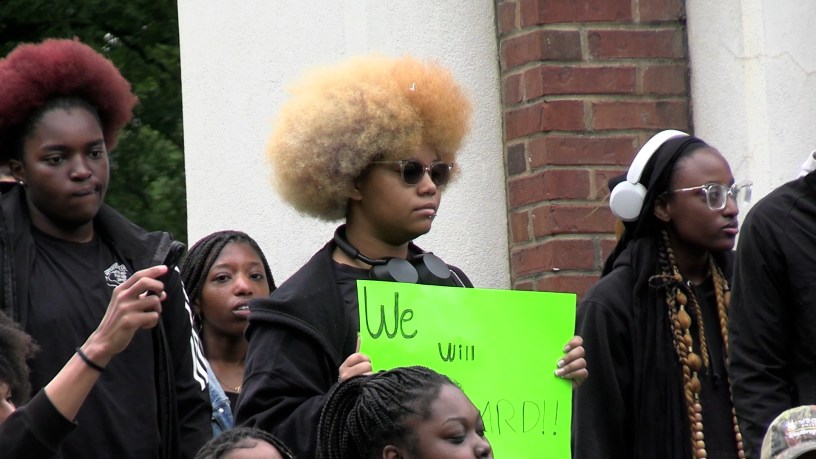
(Rock Hill, S.C.) — “We are united. We are United. We are United,” a crowd of dozens of Winthrop University students shouted, as they gathered to protest perceived racism among the school’s leadership.
The peaceful demonstration, April 28, started at the Winthrop amphitheatre and then students marched across the campus to show their displeasure with allegations of racist comments made by university leaders.
“A cabinet member was found to have used the ‘N-Word’ with the heavy e-r,” student Le’Daviah Terry, a psychology major, told the crowd through a megaphone.
“We’re coming together for something serious that means something to us. This is our life and this is what we stand for,” said Peyton Thomas, a freshman studying business administration.
Students also said they were upset about what they see as a lack of action or accountability.
In May 2025, former Winthrop attorney Todd Hagins filed a federal Equal Employment Opportunity Commission (EEOC) complaint, alleging racial discrimination by the university, after he said he was fired for failing to retaliate against an employee who reported racism at the school.
In December, a second employee, Amy Bailey, was fired after she filed a separate EEOC complaint alleging that she heard an employee in the president’s office use the “N-word” on at least two different occasions.
Winthrop has denied both allegations, citing misconduct as the reason for Bailey’s termination.
In a statement released to students, faculty, staff and online, the university says it has thoroughly investigated the allegations and that the accusations by Hagins are “false and misleading.”
It also calls Hagins a “disgruntled employee” who “has engaged in a retaliatory campaign to harm Winthrop” and its reputation.
The release is signed by Winthrop President Edward Serna and Joel Hamilton, chair of the school’s Board of Trustees. Both are also Winthrop graduates.
“First and foremost, the allegations of race discrimination against Winthrop are false. Winthrop has a long and proud history of openness, equal opportunity, and non-discrimination that continues to this day. We are proud that Winthrop’s student body reflects the racial demography of our state,” Serna and Hamilton said, via the statement.
About a third of the students at Winthrop are African-American and another 40% are first generation students, with many of those often coming from minority communities.
“We are affirming that Winthrop conducted a prompt, thorough, and professional investigation of the internal employee complaint and took appropriate remedial action. That is our duty under the law. We take that responsibility seriously and are letting you know since that time we have received no similar complaints about that employee,” said Serna and Hamilton, via the statement.
“There is no place for racial comments or racial insensitivity within Winthrop, and we have taken steps to ensure compliance with these expectations.”
However, many students remain dissatisfied and they say more needs to be done.
“We actually worked with NPHC (the National Pan-Hellenic Council, which is the governing body of the historically African-American fraternities and sororities) to have a protest and they shut us down,” said Sariah Gilliam, a Winthrop junior studying political science.
“The student activities center shut us down. We went to Vice President (Shelia Higgs Burkhalter), she also shut us down,” Gilliam said.
“Then we went to (President) Serna and you know what he told us? That it was out of his hands and that he couldn’t say anything about it. Its been a year since we’ve heard about these things and we’ve been trying to make a change.”
Some students say the university needs to take action.
“We want the person, the individual, that was accused of these racial slurs fired,” said Timothy Speaks, a senior majoring in healthcare management. “We really want her fired and we also just want fair treatment for all students.
“Not just black students, but every student, because it is about equality at the end of the day and we really want all students to be able to have the equal access to everything that we want, especially Black students cause Black students really make up this campus,” said Speaks, who helped to organize the protest.
“Staff using racial slurs to talk about students, we want to protest that, because we don’t think it’s right. We want to get our voices heard and we want to make sure the administration knows that we see it. We hear it and we don’t agree with it at all,” he said.
“In the email that the president sent, he said that Winthrop was one of the most diverse campuses and most diverse community campuses in the state, but yet you still have someone in your office that has used racial discrimination, racial slurs to talk about students. So, how can you promote diversity and inclusivity when you have someone in your cabinet that goes against everything you’re promoting,” asked Speaks.
Other students say their actions go beyond a single day of protest.
“I would say my form of protest has been and always will be taking up space,” said Brendon Wilson, a Winthrop sophomore majoring in social work.
The Board of Trustees was expected to meet this week and because those meetings are open to the public some students were expected to attend and voice their concerns.
* Editor’s note: This story is updated from a previous version to add quotes from Timothy Speaks, which were provided by the Palmetto Report’s Joshua Prevette.

