Raegan Carter & Joseph Kasko
palmettoreport@gmail.com
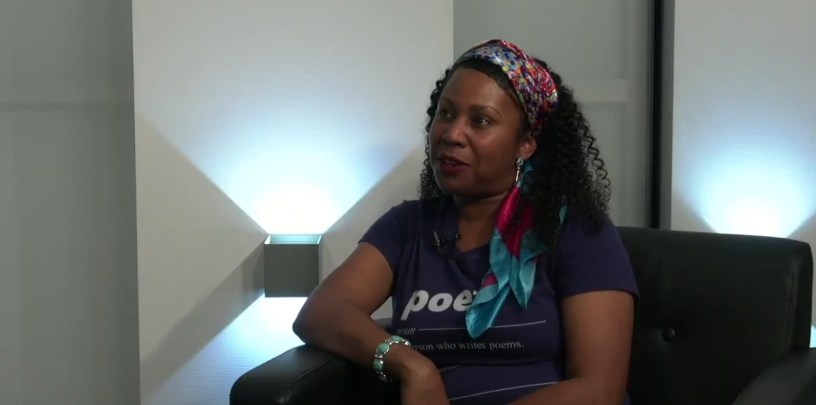
(Rock Hill, S.C.) — Rock Hill is a unique place for the arts, considering it’s one of just four cities in South Carolina that has a poet laureate, joining only Charleston, Columbia and Greenville.
It’s also unique nationally, considering that of the 35 U.S. cities with populations of 500,000 residents or more, there are only 16 with city poets laureate.
“It really means that our city values poetry, values the power of poetry, the power of community, the power that poetry has to bring community together,” said Carlo Dawson, the poet laureate for Rock Hill. “You want to use your platform to help promote poetry and really promote literacy. It’s something I dreamed about.”
Dawson was a guest on the Palmetto Report last month during National Poetry Month and this year marked the 30th anniversary of the month launched by the Academy of American Poets in April 1996.
Dawson has served as an educator in the Rock Hill School District for more than 20 years, where she currently serves as the dean of student leadership, but she has also taught creative writing, art and journalism.
She is the second person to hold the honorary poet laureate position in the city, which was created in 2018 and is managed by the Poet Laureate Committee.
“I only thought about U.S. poet laureates, I never knew that our city would have a city poet laureate, but when it came to the city and our first poet laureate was Angelo Jeter,” she said. “So when when it did come to the city, I knew that I wanted to apply for it and so I applied and did all the things and I’m very grateful and honored to be the Rock Hill poet laureate.”
Dawson, who was named poet laureate last May, often visits schools or hosts workshops in order to promote poetry in the community.
“I was at a middle school doing a poetry workshop all day (last month) and it was wonderful just to pour into young people and just really show how poetry can be used to uplift them, to save their lives, to show how writing is in everything that they do and see and love,” she said.
Dawson said she first became interested in poetry after facing bullies in school, which inspired her to write creatively in her journal.
“I read Maya Angelou’s poetry and her book ‘I Know Why the Caged Bird Sings’ and I saw that she was selectively mute, as well, and so in public I didn’t speak a lot and at home I talked all the time, but that allowed me to see how poetry saved my life,” she said.
“So, I went to school to be a writer. I majored in English and then I went back and became an educator, because I knew that writing saved my life and I wanted to give that back to students. So, I’ve had the opportunity to see how writing has just saved the lives of so many young people and so many people I know.”
Dawson said she finds young people are generally open to learning more about poetry.
“I think once young people get the opportunity to see, ‘I don’t have to write in complete sentences when I write poetry’ and really you get to play around with the language. I mean just think, you can say that ‘the sun is a dog’ and it works in poetry. So, I think just being able to create worlds. I think once young people realize you can play around with words and language and lines and all of that; that’s when you start to see their minds open up,” she said.
Dawson is also a published author and is the founder and director of the non-profit group the Power of PROGENY.
“The acronym stands for Pioneers Reaching Out for the Greater Elevation of our Nation’s Youth,” she said. “Really in my first year of teaching, I had where young people came to me and they wanted to start a party organization.
“So, we started talking and I said ‘why don’t we do something to allow people to be seen.’ This was about 25 years ago and I think that little girl in me wanted to be able to give that back to young people after being bullied,” she said.
“I remember those first set of students. They are all grown, very grown, and…they’ve become friends now and just to see where they’ve evolved. But, really the organization is about giving a sense of belonging and leadership through the arts.”
Last month, Dawson started a Facebook group called Rock Hill Voices, that is intended to be a space for poets, storytellers and other creatives to get together and share their work.
Please consider following the Palmetto Report on Facebook or X (formerly Twitter) and you can find and subscribe to our digital content on YouTube and Spotify.

